

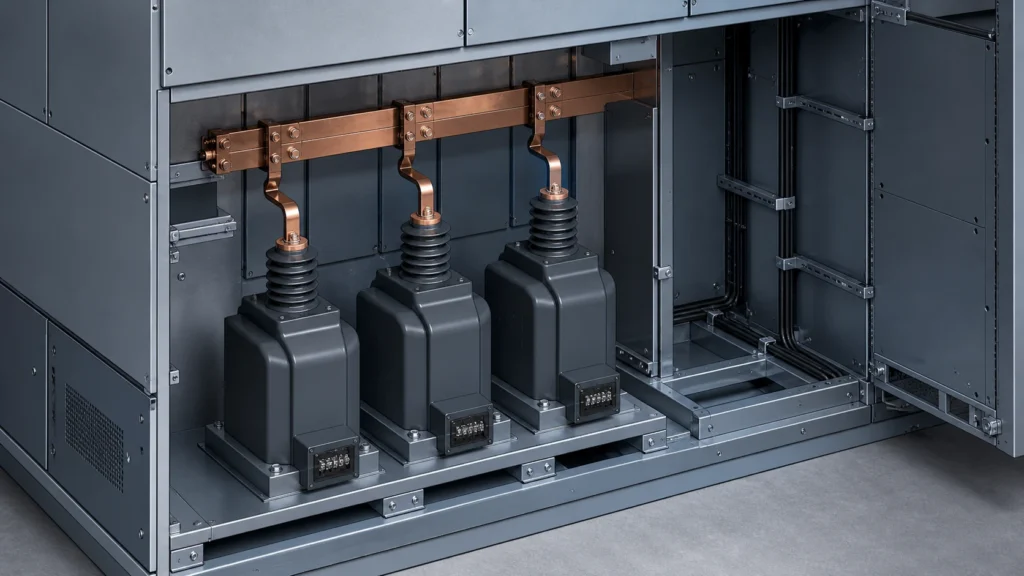
Quick Takeaway
- Confirm the project duty and applicable requirements for Instrument Transformers before selection or service work.
- Use recorded inspection and test evidence instead of unsupported assumptions.
- Keep the final acceptance, maintenance, and handover documents with the equipment record.
A voltage transformer ratio cannot be reviewed, verified, or approved without a defined set of system-level information that describes the electrical environment, the application purpose, and the applicable standards framework. Missing even one parameter — system voltage class, burden, or accuracy requirement — can invalidate a ratio selection after procurement. This guide identifies every piece of system information an engineer or procurement team must assemble before submitting a VT ratio for technical review, without crossing into ratio selection or protection-setting territory in the Instrument Transformers context.
Why System Information Precedes VT Ratio Evaluation
A VT ratio is not a standalone specification. It is a consequence of the system it serves. The primary winding voltage derives from the nominal system voltage and the maximum continuous operating voltage. The secondary winding voltage is standardized (typically 110 V or 110/√3 V in IEC practice), but the ratio still depends on whether the transformer is connected phase-to-phase or phase-to-ground. Without confirmed system topology and grounding method, the ratio written on a nameplate is ambiguous.
Procurement teams sometimes treat the ratio as the first item to confirm. In practice, ratio confirmation is one of the last valid steps, because it depends on inputs from protection engineering, metering engineering, and the system design authority. Beginning a technical review without those inputs wastes review cycles and risks ordering a transformer with the correct ratio but the wrong burden class, insulation level, or accuracy designation — any of which can force a reorder.
Electrical System Parameters
Every VT ratio review begins with the parameters that define the voltage environment the transformer must withstand and accurately reproduce.
**Nominal system voltage and highest system voltage.** The rated primary voltage of the VT must correspond to the nominal system voltage, but the insulation and thermal design must accommodate the highest voltage for equipment, which accounts for sustained overvoltage conditions. These two values are not interchangeable and must both appear in the documentation package.
**System grounding method.** An effectively grounded system, an impedance-grounded system, and an isolated or resonant-grounded system each impose different voltage stresses on VTs during single-line-to-ground faults. A VT connected phase-to-ground on an isolated neutral system can see sustained full line-to-line voltage across its insulation. The grounding method directly determines the rated voltage factor and its permissible duration, both of which must be specified alongside the ratio.
**Frequency.** While 50 Hz or 60 Hz is usually known, the value must be explicitly stated. A VT designed for one frequency will exhibit different magnetizing current and accuracy behavior at the other.
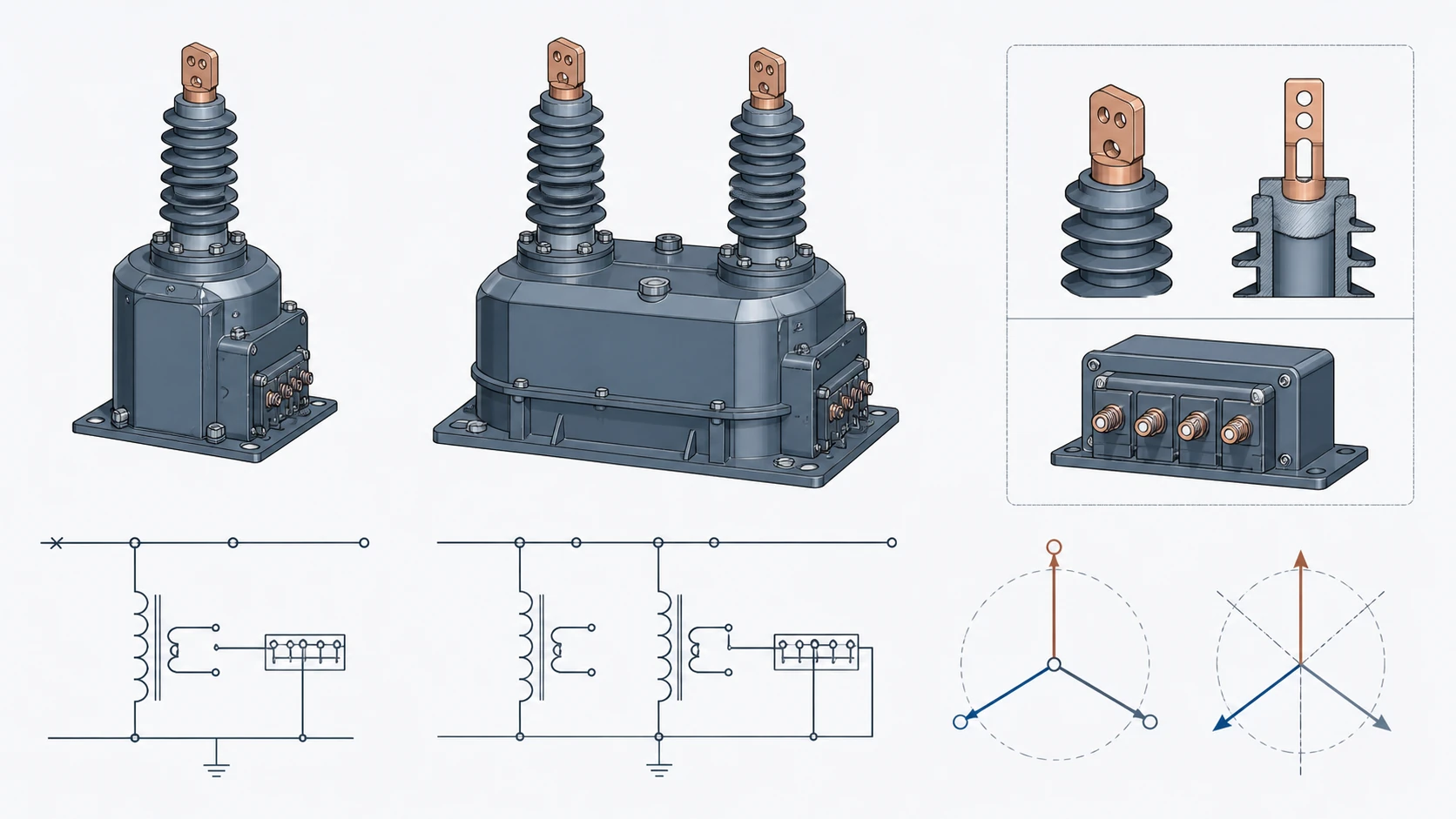
**Connection configuration.** Whether the VT is connected phase-to-ground or phase-to-phase changes the required primary voltage rating for a given system voltage. A phase-to-ground VT on a 20 kV system has a different rated primary voltage than a phase-to-phase VT on the same system. The connection also determines whether a single-pole or double-pole construction is needed — a distinction ABB documents across its indoor voltage transformer families, where single-pole and double-pole designs serve different installation and insulation requirements in the broader MV Switching Equipment assembly.
Application Purpose and Functional Requirements
The same VT ratio can appear on transformers built for fundamentally different jobs. The application determines accuracy class, burden limits, and transient-response requirements.
**Metering versus protection.** A metering VT must maintain accuracy within a narrow band around rated voltage, typically 80 % to 120 % of rated primary voltage, to support revenue-grade energy measurement. A protection VT must maintain acceptable accuracy across a much wider voltage range, often down to 5 % and up to the rated voltage factor, to ensure correct relay operation during faults. Some transformers carry dual-rated windings. Whether dual rating is needed must be confirmed before review because it affects core design and cost.
**Residual voltage (open-delta) output.** If the VT set must supply a residual voltage output for earth-fault detection, the review must confirm that three single-phase VTs with an open-delta-connected secondary are specified, and that the additional winding burden is accounted for.
**External power-supply duty.** ABB identifies external power-supply applications as a distinct use case for indoor voltage transformers. When a VT secondary also supplies auxiliary power — for example, feeding small control circuits in remote or unmanned installations — the additional continuous burden changes the thermal and accuracy picture. This duty must be declared explicitly.
Burden and Accuracy Documentation
Burden and accuracy are inseparable from the ratio, yet they are the parameters most often left incomplete in procurement documents.
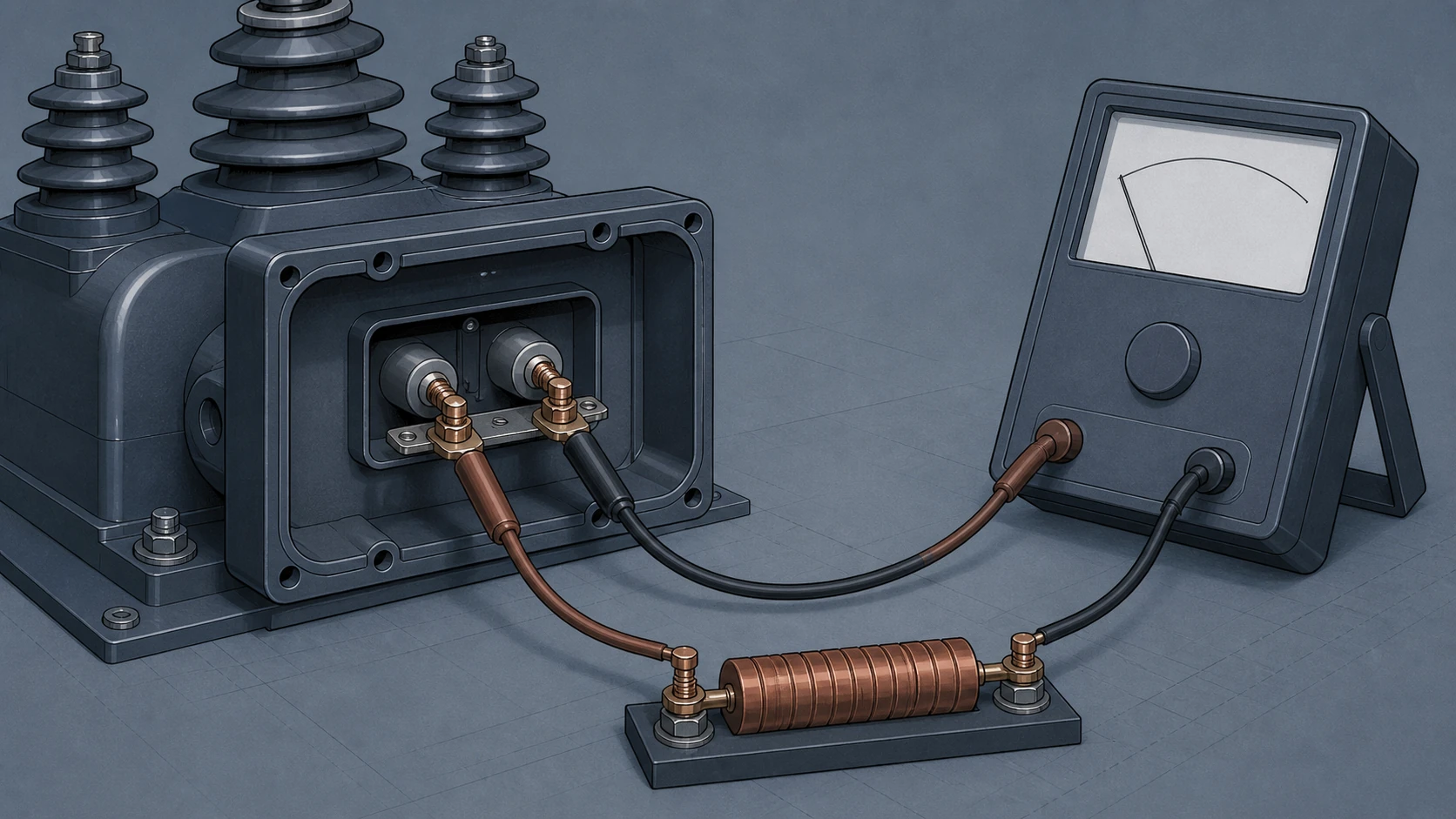
**Connected burden in VA and power factor.** The total VA burden on each secondary winding, including instrument loads, relay coils, pilot-wire impedance, and wiring losses, must be calculated and documented. Burden is not a catalog default; it is a site-specific value derived from the actual devices and cable runs connected. Understating burden can push the VT outside its accuracy class. Overstating it may lead to specifying a physically larger and more expensive transformer than necessary.
**Accuracy class and rated burden.** IEC 61869-3 defines additional requirements for inductive voltage transformers used with electrical measuring instruments and protective devices. The required accuracy class (for example, 0.2 or 0.5 for metering, 3P or 6P for protection) and its associated rated burden must appear in the review package. These values constrain the core material, winding design, and acceptable ratio error — so they must be settled before the ratio is confirmed, not after.
**Number of secondary windings.** A VT may carry one, two, or three secondary windings serving different purposes (metering, protection, open-delta). Each winding has its own accuracy class and burden rating. The review must account for the mutual influence of loaded windings on total accuracy.
Insulation and Environmental Conditions
A correct ratio installed in the wrong insulation class or environment is a latent failure.
**Rated insulation level (BIL and power-frequency withstand).** The rated lightning impulse withstand voltage and the short-duration power-frequency withstand voltage must match the system's insulation coordination study. These values are tied to the highest voltage for equipment, not to the nominal system voltage alone.
**Installation environment.** Indoor and outdoor ratings govern enclosure, creepage distance, and material choices. ABB's indoor voltage transformer documentation illustrates how construction differs for indoor service. If the VT will be installed in a metal-enclosed switchgear assembly, the dimensional and dielectric coordination requirements of that assembly also apply.
**Altitude and ambient temperature.** Standard ratings assume specific altitude and temperature ranges. Installations above 1 000 m or outside standard ambient limits require derating or special design, both of which affect whether a given standard transformer can be applied at the stated ratio and burden.
Standards Framework and Compliance Scope
A technical review is anchored to a standards edition. Ambiguity here can delay approval or create contractual disputes.
**Applicable standard and edition year.** IEC 61869-3 is the current international standard governing additional requirements for inductive voltage transformers. Older installations may reference the superseded IEC 60044-2. The specific edition must be stated because test requirements, accuracy definitions, and rated voltage factors have changed between editions. A review conducted against the wrong edition can approve a transformer that does not meet the project's contractual standard.
**Supplementary or national standards.** Some utilities and grid codes impose requirements beyond IEC 61869-3, including specific accuracy classes, ferroresonance withstand tests, or partial-discharge limits. These must be listed in the review package.
**Type-test and routine-test requirements.** The review should confirm which tests the purchaser requires evidence of — type tests from an existing design, routine tests on delivered units, or special tests. This affects whether an off-the-shelf ratio is acceptable or whether a new type test is needed, which changes lead time and cost.
Information Checklist for RFQ and Replacement Decisions
Rather than assembling information after a supplier returns questions, use the instrument-transformer selection-data checklist before a VT ratio enters technical review. Each item below resolves a specific dependency described in the sections above.
| Category | Required Information | Decision It Resolves |
|---|---|---|
| System voltage | Nominal voltage, highest voltage for equipment | Primary winding rating, insulation level |
| Grounding | System grounding method | Rated voltage factor and duration |
| Frequency | 50 Hz or 60 Hz | Core and accuracy design basis |
| Connection | Phase-to-ground or phase-to-phase | VT construction (single-pole / double-pole), rated primary voltage |
| Application | Metering, protection, dual, power supply | Accuracy class range, core type |
| Burden | Total VA per winding with power factor | Accuracy verification, thermal rating |
| Accuracy | Class per winding, rated burden per winding | Ratio-error and phase-displacement limits |
| Windings | Number and purpose of secondary windings | Mutual loading effects |
| Insulation | BIL, power-frequency withstand | Insulation coordination compliance |
| Environment | Indoor/outdoor, altitude, ambient temperature | Enclosure, derating, creepage |
| Standards | Applicable standard and edition, supplementary specs | Test and acceptance criteria |
| Tests | Type-test, routine-test, special-test scope | Lead time, cost, design validation |
For replacement decisions, the existing VT nameplate data provides a starting reference, but it does not replace a current system study. System modifications since original installation — load additions, grounding changes, relay upgrades — may have changed the burden, accuracy requirement, or voltage factor, making a like-for-like replacement technically incorrect even if the ratio stays the same. The mounting and cubicle interface should also be checked against the relevant MV switchgear components record.
Common Gaps That Stall Technical Reviews
Three documentation gaps recur in practice and are worth anticipating.
**Burden stated as "standard" without a calculation.** A review engineer cannot verify accuracy compliance against an unquantified burden. The connected instrument list and cable-run lengths must be provided.
**Grounding method omitted or described generically.** Stating "grounded system" is insufficient. The review needs to distinguish between effectively grounded (voltage factor 1.2 continuous), impedance-grounded, and isolated or resonant-grounded (voltage factor 1.9 for 8 hours or 1.2 continuous, depending on fault-clearing practice) configurations.
**Mixed standard references.** Specifying IEC 61869-3 for accuracy but referencing IEC 60044-2 test procedures creates contradictions. The standards framework must be internally consistent.
Resolving these gaps before submission avoids a review cycle that produces questions instead of approvals.
FAQ
What is a VT ratio in instrument transformers?
A VT ratio is the defined relationship between the primary winding voltage and the secondary winding voltage of a voltage transformer. It allows high system voltages to be accurately scaled down to standardized low voltages — typically 110 V or 110/√3 V — for safe connection to metering instruments, protective relays, and control devices. The ratio is a design output that depends on the system voltage, the transformer's connection configuration, and the applicable standards framework.
What is the minimum system information needed to review a VT ratio?
At minimum, a technical review requires the nominal system voltage, highest voltage for equipment, system grounding method, connection configuration (phase-to-ground or phase-to-phase), intended application (metering, protection, or both), total connected burden per secondary winding, required accuracy class per winding, rated insulation levels, installation environment, and the applicable standard with edition year. Omitting any of these can result in a technically incomplete review.
What is the role of IEC 61869-3 in a VT ratio review?
IEC 61869-3 establishes the additional requirements for inductive voltage transformers beyond the general requirements in IEC 61869-1. It defines accuracy classes, rated voltage factors, burden conventions, and test procedures that a VT must satisfy. A ratio review references this standard to confirm that the proposed transformer meets the accuracy and insulation requirements for its declared application. The specific edition year matters because definitions and test requirements have evolved from the earlier IEC 60044-2 series.
What is the difference between system information for metering VTs and protection VTs?
Metering VTs require precise burden data and strict accuracy class verification across a narrow voltage band near rated voltage, because metering errors directly affect revenue. Protection VTs require verification across a much wider voltage range — from a small percentage of rated voltage up to the rated voltage factor — because relays must operate correctly during fault conditions when voltages may collapse or rise. Both need the same foundational system information, but protection applications additionally require confirmation of the rated voltage factor, its permissible duration, and the transient performance expectations of the connected protection scheme.
What is the risk of submitting a VT ratio for review without complete system information?
The primary risk is an extended review cycle: the reviewing engineer will return the submission with technical queries rather than an approval. A secondary and more costly risk is that an incomplete review approves a transformer that later proves unsuitable — for example, a VT with the correct ratio but an inadequate voltage factor for the actual grounding method, or an accuracy class validated against a lower burden than is actually connected. Either outcome can delay commissioning, require equipment replacement, or compromise measurement and protection performance after energization.

