

Quick Takeaway
- Confirm the project duty and applicable requirements for Disconnect Switches before selection or service work.
- Use recorded inspection and test evidence instead of unsupported assumptions.
- Keep the final acceptance, maintenance, and handover documents with the equipment record.
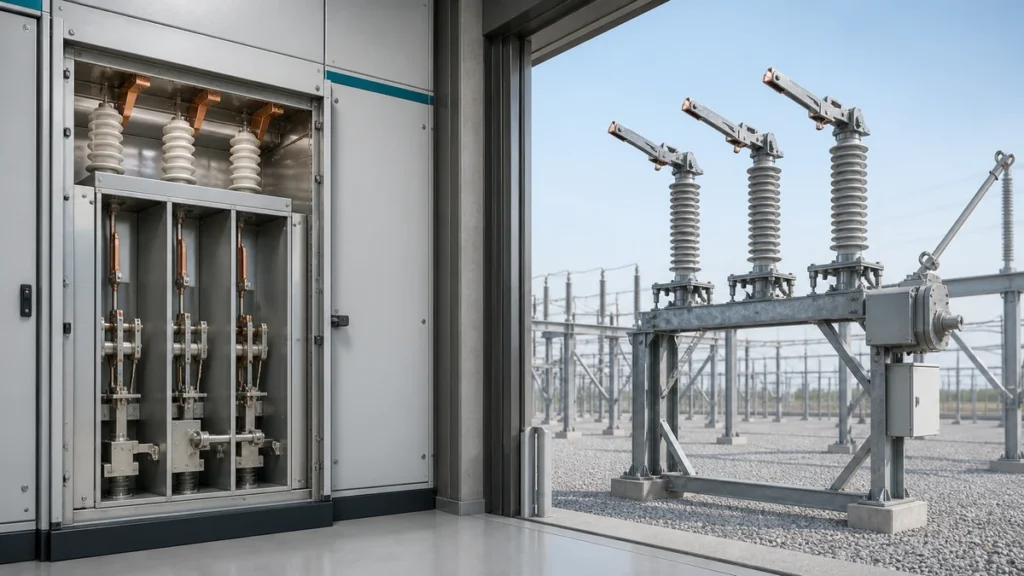
Selecting the wrong enclosure class for a disconnect switch is one of the more consequential procurement errors in medium-voltage projects — the fix is rarely a simple swap after installation. The Disconnect Switches selection context is the product-family starting point, but the core decision turns on declared installation conditions, not product family names: IEC 62271-1:2017 explicitly requires that service conditions be declared rather than assumed, and IEC 62271-102:2018 sets the type-test framework for both indoor and outdoor disconnectors above 1 kV. Confirm the environmental, mechanical, and interface data listed below before issuing an RFQ or approving a replacement.
| Factor | Indoor | Outdoor |
|---|---|---|
| Governing standard scope | IEC 62271-102 (indoor variant type tests) | IEC 62271-102 (outdoor variant type tests) |
| Enclosure / housing | Switchroom or GIS bay provides shelter | Self-contained weatherproof housing required |
| Pollution degree (IEC 62271-1) | Typically PD2–PD3 | PD4 or site-declared higher |
| Creepage / clearance requirements | Lower (cleaner, drier air) | Higher (rain, condensation, biological fouling) |
| UV and thermal cycling loads | Minimal | Continuous; UV-stable materials required |
| Seismic / wind load design | Per building structure | Free-standing; site wind and ice loads govern |
| Corrosion protection | Standard paint / plating | Hot-dip galvanising or equivalent |
| Heater / anti-condensation elements | Optional | Usually mandatory |
| Maintenance access | Controlled indoor environment | All-weather access provisions required |
| Typical interface | Bus bar, GIS, indoor switchgear | Overhead line, cable termination, outdoor substation |
Why Declared Conditions Govern — Not the Product Label
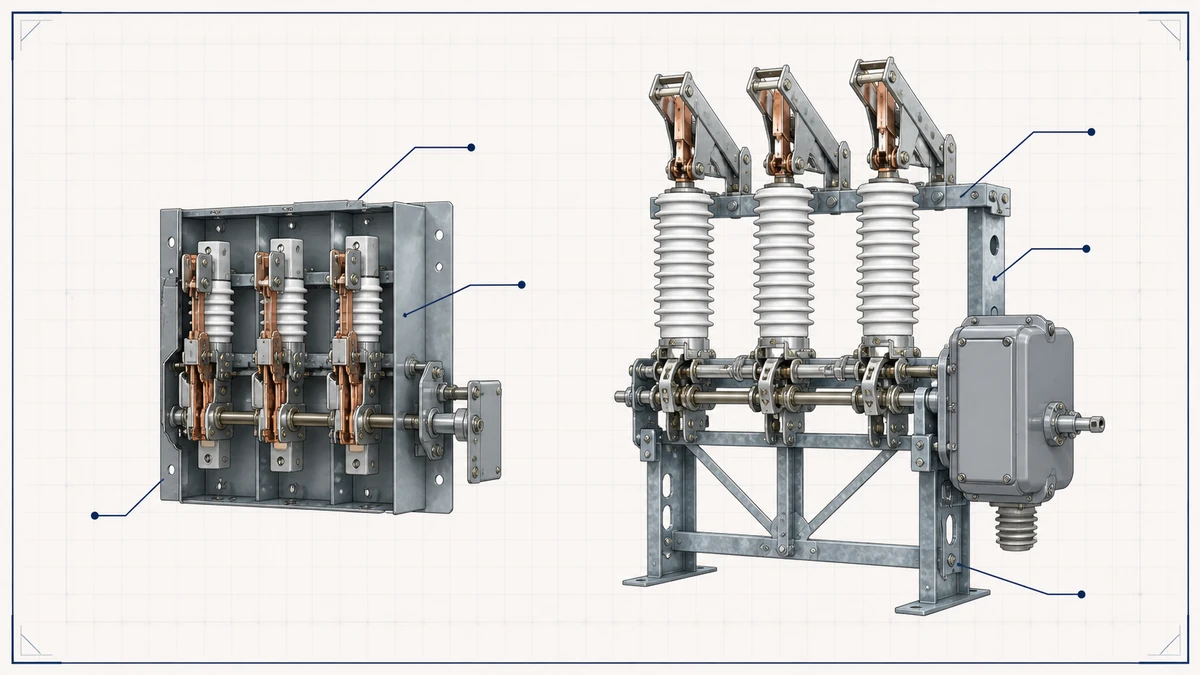
IEC 62271-1:2017 defines normal service-condition ranges as a reference baseline, but it requires the actual installation conditions to be explicitly declared — the standard's own wording distinguishes indoor and outdoor environments by their characteristic exposure ranges, not by what a manufacturer calls a product family. This matters because a disconnect switch labelled "outdoor" in a catalogue may have been type-tested to one pollution degree, one altitude band, or one ice-load category. If your site conditions fall outside those tested limits, the switch is not a verified match regardless of the label.
The practical implication: every project declaration should identify pollution degree, maximum altitude, ambient temperature range, humidity regime, and any special conditions (coastal salt spray, industrial atmospheric contamination, seismic zone) before a product is shortlisted. Mismatches between declared conditions and tested conditions are a type-approval gap that affects both in-service reliability and regulatory acceptance.
Functional and Mechanical Distinctions That Drive the Decision
A disconnect switch — disconnector in IEC terminology — is a mechanical isolation device, not an interrupting device. IEC 62271-102:2018 covers AC disconnectors and earthing switches for installations above 1 kV and establishes type-test sequences that differ between indoor and outdoor variants because the failure modes differ. Where the declared duty includes routine load interruption rather than isolation alone, review the distinct Load Break Switches role instead of treating the disconnector as an interchangeable alternative.
Indoors, the dominant failure drivers are insulation degradation under sustained humidity or contamination ingress from an imperfect switchroom environment, and mechanical wear from thermal cycling in a relatively stable temperature band. The type tests reflect this: electrical endurance, dielectric strength at rated pollution level, and mechanical endurance.
Outdoors, the design must also withstand direct rain and ice accumulation on live parts, UV degradation of insulating materials, wind-induced mechanical loads on open-blade or pantograph mechanisms, and the harder-to-predict effects of biological fouling (bird nesting, insect ingress). The outdoor type-test sequence adds rain tests, ice-load tests, and higher creepage requirements. The mechanical design of an outdoor disconnector — including blade geometry, contact spring force, and operating mechanism sealing — must be verified against these additional tests, not just against the indoor sequence.
The earthing switch function, when incorporated, is governed by the same standard and its enclosure class follows the same declared-condition logic. Do not assume that an earthing switch certified as part of an indoor assembly can be redeployed in an outdoor role without separate verification.
The Enclosure and Insulation Interface
One underappreciated selection dependency is how the disconnect switch interfaces with the rest of the installation. An indoor disconnector mounted in a Metal Clad Switchgear panel is partly protected by the panel's own enclosure rating; the disconnector's own pollution-degree rating is supplemented by the panel. Strip the same disconnector out of that panel and mount it in an outdoor structure, and it is now operating at the full outdoor pollution degree without the supplemental protection — a condition it was never type-tested for.
The reverse mismatch is less common but does occur during refurbishment: an outdoor-rated disconnector placed inside a new indoor GIS bay may have creepage distances and insulator profiles optimised for high-pollution outdoor use, which can create layout and clearance complications inside the bay.
Before finalising a selection, confirm:
– Whether the disconnector's rated pollution degree matches the declared site condition independently — not just as installed in a particular panel
– Whether cable or busbar termination hardware supplied with the switch is rated for the same environment as the switch body
– Whether surge arrester coordination has been reviewed for outdoor overhead-line interfaces, where lightning and switching surges arrive directly at the terminal
Standards Scope and Evidence Boundaries
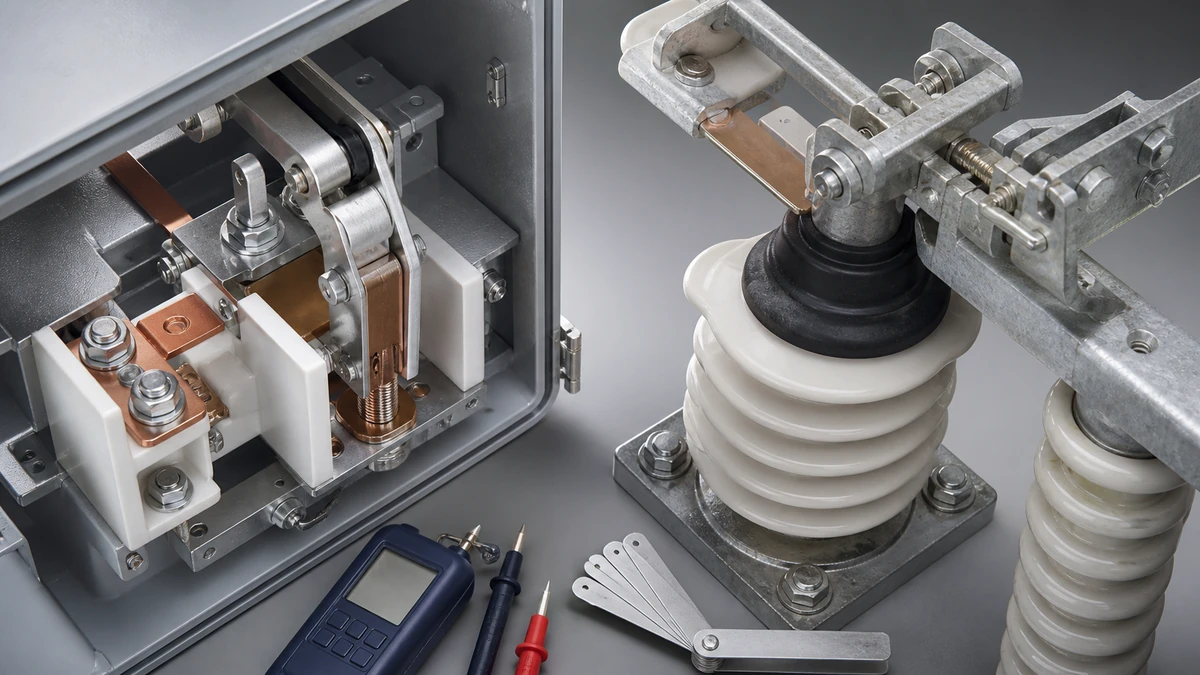
IEC 62271-102:2018 is the primary type-test and rating standard for disconnectors and earthing switches above 1 kV. It establishes rated values (voltage, current, short-time withstand, peak withstand, frequency of operation), the test sequences that verify them, and the marking requirements that link a delivered product to its verified ratings.
IEC 62271-1:2017 is the common specification that sits beneath 62271-102 and defines the environmental envelopes — normal service conditions and deviations from normal — that the installation designer must declare. The two standards work together: 62271-1 tells you what conditions to declare; 62271-102 tells you what tests the product passed against declared conditions.
What the standards do not do: they do not certify a specific product for your specific site. Type testing demonstrates that a product design meets the standard's requirements under controlled laboratory conditions representing the declared class. The engineering judgment that a specific site's conditions fall within a declared class belongs to the project engineer, not to the type-test certificate. That boundary — between what the standard certifies and what the engineer must declare — is where most indoor/outdoor selection errors originate.
When reviewing type-test certificates, confirm the pollution degree, altitude class, and any special environmental conditions listed on the certificate match your declared site conditions. A certificate issued to a lower pollution degree or a lower altitude class than your site requires is not a valid basis for installation.
Pre-RFQ Checklist: Data to Confirm Before Selecting
Gather all of the following before shortlisting or issuing an RFQ. Missing data in any category should trigger a hold, not an assumption.
**Site and environmental conditions (per IEC 62271-1 declaration):**
– Rated maximum voltage and system voltage class
– Pollution degree (PD1 through PD4, or higher if site-specific conditions apply)
– Altitude (standard ≤ 1000 m; derate or specify above)
– Ambient temperature range (minimum and maximum, not just design operating temperature)
– Humidity regime (condensing or non-condensing; indoor switchrooms with poor HVAC can reach condensing conditions)
– Special atmospheric conditions: coastal or industrial salt, SO₂, H₂S, agricultural chemical exposure, high UV
– Seismic zone (required for outdoor free-standing structures and for indoor installations in seismic areas)
– Wind and ice loading (outdoor; site-specific, not regional generic)
**Electrical parameters:**
– Rated normal current and load profile
– Rated short-time and peak withstand current (fault level at the point of installation)
– Rated insulation level (rated lightning impulse withstand voltage and rated power-frequency withstand voltage)
– System earthing (solidly earthed, impedance earthed, unearthed — affects earthing switch selection)
– Required making current for earthing switch, if applicable
**Mechanical and interface parameters:**
– Operating mechanism type (manual, motor-operated, spring-stored)
– Required number of operations per year (affects mechanical endurance class per IEC 62271-102)
– Interlocking requirements (key interlocks, mechanical interlocks with circuit breakers, earthing switch sequencing)
– Bus bar or cable termination configuration and phase spacing
– Position indication and auxiliary contact requirements for SCADA or protection relay interfaces
– Mounting arrangement (floor-mounted, wall-mounted, overhead; indoor bay or outdoor structure)
**Procurement and approval dependencies:**
– Local or national regulatory body requirements that supplement IEC (some jurisdictions require additional national approvals or local utility standards)
– Project specification requirements for corrosion protection class, paint system, or nameplate language
– Spare parts availability and service network for the selected manufacturer in the installation region
When this declaration and the existing interface record are complete, send them through Contact Us for a quotation review tied to the stated installation conditions rather than to a generic indoor or outdoor label.
Installation, Inspection, and Commissioning Boundary
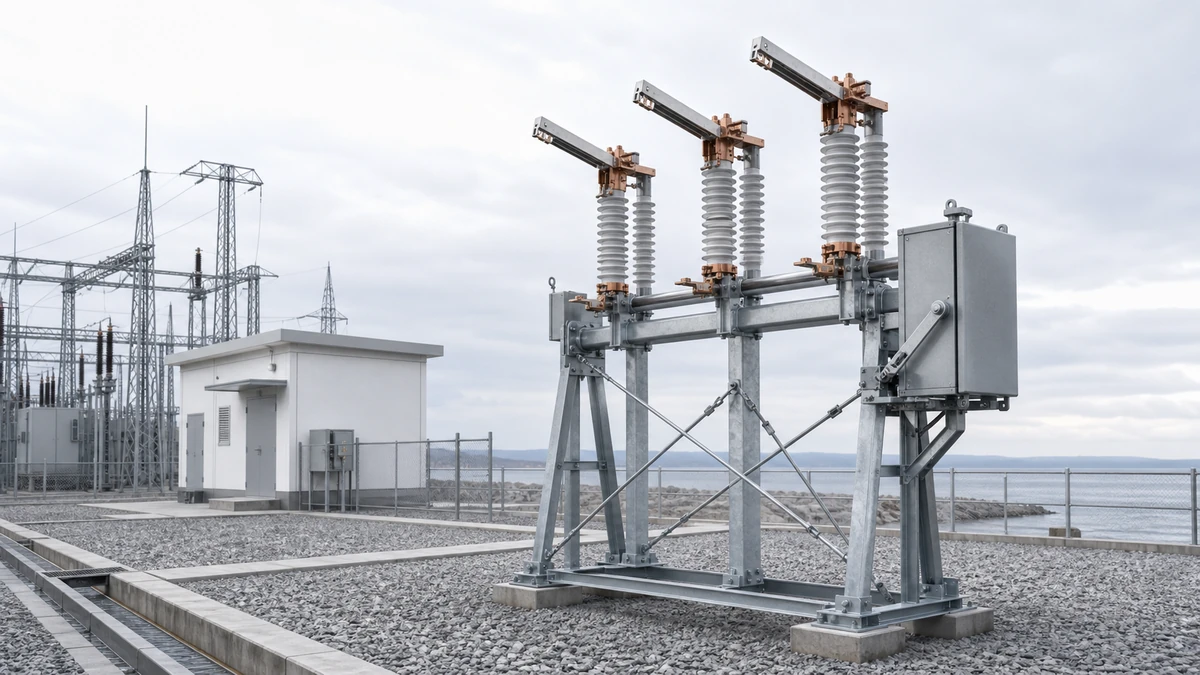
This checklist covers selection-stage data. Once a disconnect switch is delivered, installation, pre-commissioning inspection, and commissioning are governed by model-specific approved procedures from the manufacturer and by the project's engineering documentation. Actions in those phases — contact resistance measurement, mechanical travel and alignment checks, operating mechanism adjustment, interlocking verification, and any work on earthing switch springs or stored-energy mechanisms — must follow those approved procedures. Do not infer torque values, setpoints, or adjustment ranges from general application notes or from this document.
For inspection at the selection boundary, confirm that the delivered nameplate ratings match the specified ratings, that the type-test certificate pollution degree and altitude class are consistent with the declared site conditions, and that the corrosion protection class (for outdoor equipment) matches the specification. Any discrepancy between the delivered nameplate and the specification is a hold point for engineering review before installation proceeds.
Factory acceptance testing (FAT) requirements should be defined at the RFQ stage, not after order placement — especially for high-fault-level installations or unusual environmental conditions where additional dielectric or mechanical verification beyond routine production tests may be warranted.
Replacement and Refurbishment Decisions
Replacing an existing disconnect switch introduces two selection traps that new installations do not face.
The first is condition assumption: an existing indoor switch that has been in service for years in a switchroom with deteriorating HVAC may have been operating at effective pollution and humidity levels higher than its original declaration. Replacing like-for-like without reviewing current service conditions may replicate a marginal installation rather than correct it.
The second is interface mismatch: replacement switches must match not only the voltage and current ratings but the mechanical interfaces — phase spacing, connection lug dimensions, mounting bolt pattern, and operating mechanism shaft position. A switch from a different manufacturer or a newer product generation may have updated terminal configurations that require busbar modification. Confirming dimensional compatibility before order placement avoids costly site rework.
For life-extension assessments of existing outdoor disconnectors, the condition of insulator surfaces (tracking, chipping, biological fouling), contact silver plating wear, and operating mechanism lubrication and sealing condition are the primary indicators. Model-specific approved procedures govern any inspection, measurement, or maintenance actions on these components.
FAQ
What is the primary standard that covers indoor and outdoor disconnect switches above 1 kV?
IEC 62271-102:2018 covers AC disconnectors and earthing switches for both indoor and outdoor installations above 1 kV. It establishes rated values, type-test sequences, and marking requirements. IEC 62271-1:2017 sits alongside it as the common specification defining normal and abnormal service conditions — it is the standard that requires installation conditions to be declared explicitly rather than assumed from a product label.
What is pollution degree and why does it affect the indoor vs outdoor decision?
Pollution degree is a classification defined in IEC 62271-1 that describes the level of conductive or hygroscopic contamination the equipment will encounter in service. Indoor installations in clean, controlled environments typically fall in PD2 or PD3. Outdoor installations, or indoor installations in contaminated industrial environments, may be PD4 or require a site-specific higher declaration. The pollution degree drives creepage distance requirements — the minimum surface path length along insulator surfaces between live parts and earth. An undersized creepage distance for the actual site pollution level leads to tracking, flashover, and insulation failure over time.
What is the difference between a disconnector and a circuit breaker in this context?
A disconnector (disconnect switch) is a mechanical isolation device. It is designed to open and close a circuit only when it carries negligible current — it does not have arc-interrupting capability for load or fault currents. Its purpose is to provide visible isolation for maintenance and safety. A circuit breaker interrupts load and fault currents. IEC 62271-102 governs disconnectors; IEC 62271-100 governs high-voltage circuit breakers. Specifying a disconnector where a load-break or fault-interrupting function is required is a design error, not a product variant choice.
What is the consequence of using an indoor-rated disconnect switch in an outdoor installation?
An indoor-rated disconnector tested to a lower pollution degree and without rain, UV, or ice-load type tests will be exposed to environmental stresses it was never verified to withstand. In the near term, surface tracking on insulators and corrosion of contact and mechanism components are the primary risks. Over time, insulation breakdown and mechanical failure of the operating mechanism become probable. Beyond the reliability risk, there is a type-approval gap: the installation cannot be shown to comply with the declared-condition requirements of IEC 62271-1 and 62271-102, which affects regulatory acceptance, insurance, and liability in the event of an incident.
What is the role of altitude in disconnect switch selection?
IEC 62271-1 defines normal service conditions as an altitude at or below 1000 m. Above that level, air density decreases, which reduces dielectric strength and arc-extinction performance. For disconnect switches, the primary effect is on the required dielectric withstand levels — the same gap that meets the rated lightning impulse and power-frequency withstand voltage at 1000 m will not meet it at higher altitude without correction. Equipment for high-altitude sites must be specified with the altitude declared so the manufacturer can verify that the product's tested ratings remain valid, or supply a version with increased clearances. This is a declared-condition requirement under IEC 62271-1, not an optional design margin.

