

Quick Takeaway
- Confirm the project duty and applicable requirements for MV Switchgear Components before selection or service work.
- Use recorded inspection and test evidence instead of unsupported assumptions.
- Keep the final acceptance, maintenance, and handover documents with the equipment record.
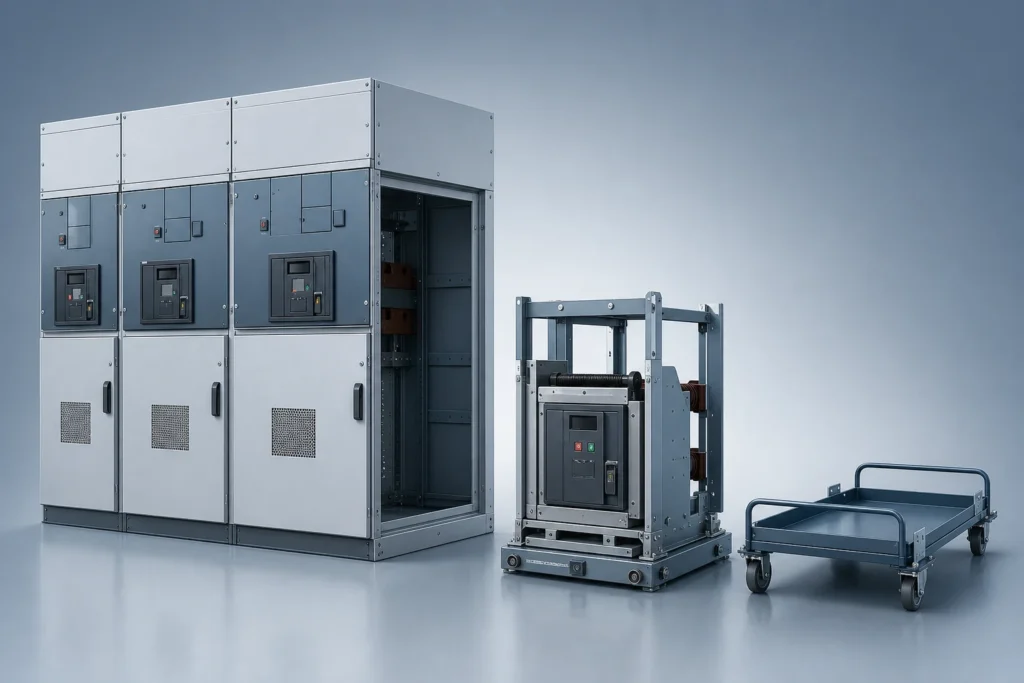
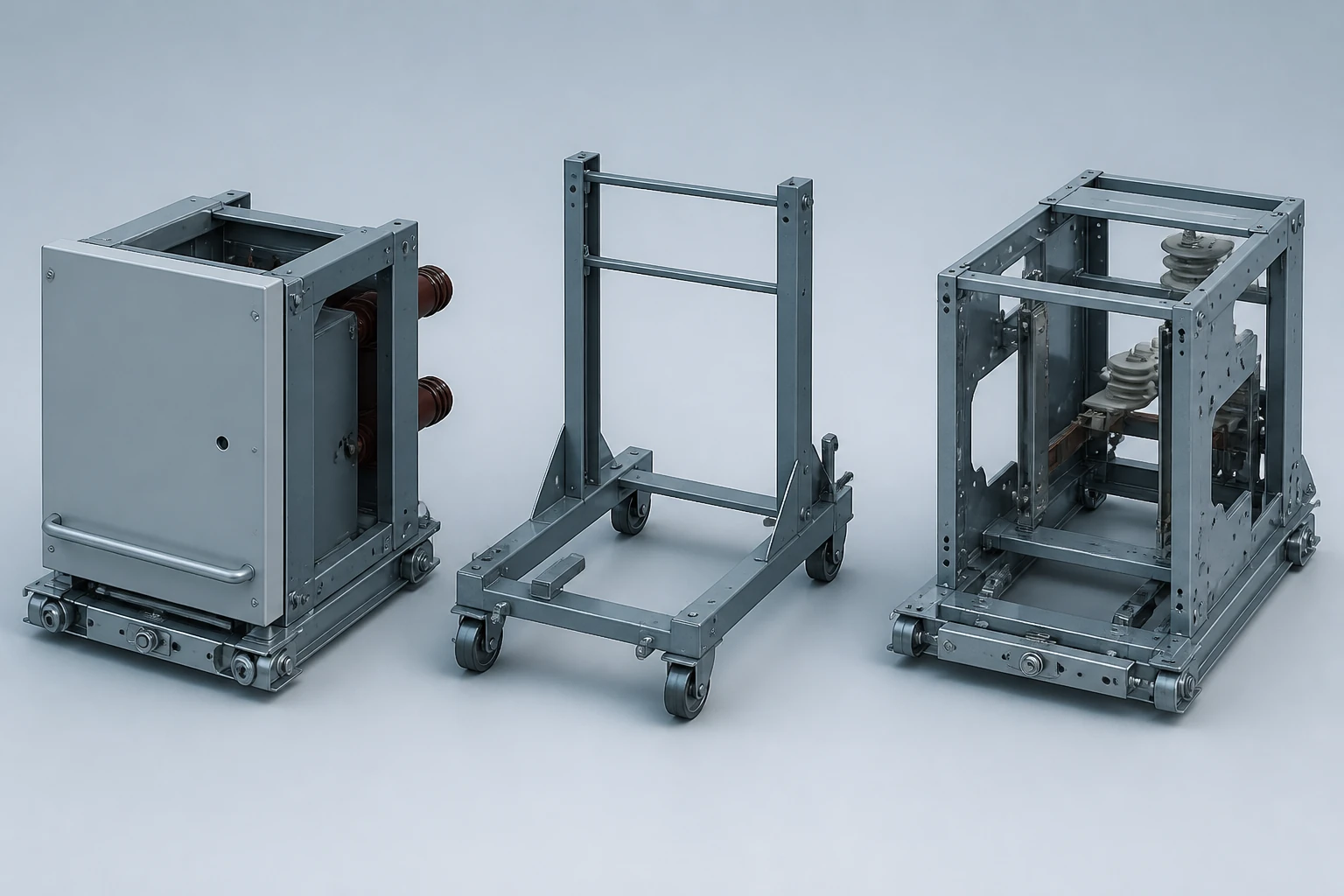
A transfer trolley, a chassis truck, and a handcart serve three separate roles in a medium-voltage switchgear component record. Substituting one name for another can lead to an incorrect RFQ because each item has a different relationship to the withdrawable part and the cubicle. A transfer trolley is OEM-documented support equipment associated with a withdrawable part. The chassis truck is the integral rolling frame that carries the switching device within its functional compartment and engages model-specific guide rails and interlocks. A handcart is a general-purpose wheeled platform with no switchgear-specific interface features. The distinction is therefore an identification and documentation issue before it is a purchasing decision.
| Attribute | Transfer trolley | Chassis truck | Handcart |
|---|---|---|---|
| Primary function | Moves withdrawable part between cubicles or to a service area | Positions and connects the switching device inside its compartment | General material handling |
| Mechanical interface | Model-specific rail adapters, latches, or docking features | Guide rails, racking mechanism, shutter trip, position interlocks | None specific to switchgear |
| Electrical interface | Normally none; acts as transport only | Primary and secondary isolating contacts, earthing provisions | None |
| Governed by switchgear OEM documentation | Yes — matched to switchgear series | Yes — integral to the withdrawable part | No |
| Interchangeable across OEM families | No | No | Broadly interchangeable |
Why the Distinction Matters at the Awareness Stage
Engineering and procurement teams encounter all three terms in maintenance contracts, spare-parts lists, and OEM literature. The risk is not theoretical. A purchase order that requests a "trolley" without specifying whether the item is the transfer trolley or the integral chassis truck can return a piece of equipment that physically cannot dock with the switchgear. Conversely, specifying a handcart when the task actually requires a transfer trolley leaves the team without the guide features needed to protect both the withdrawable part and the cubicle's internal geometry.
IEC 62271-200 defines the scope for metal-enclosed AC switchgear and controlgear assemblies, and within that scope the withdrawable part and its compartment form part of the assembly context. The standard does not prescribe a universal transfer-trolley design, which is why the OEM documentation must be consulted for the specific product family.
Functional Role of the Chassis Truck
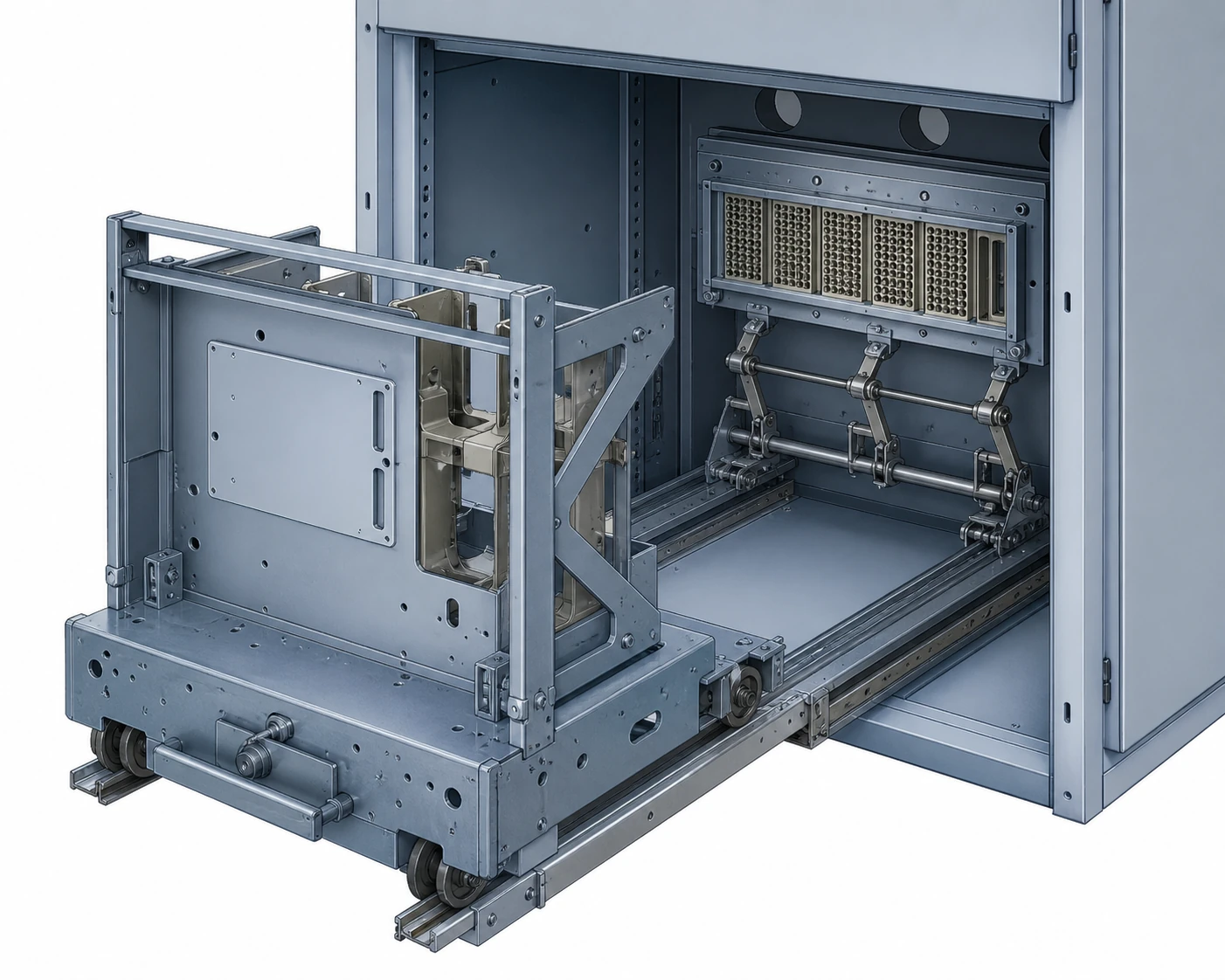
The chassis truck is not a general transport accessory. It is the mobile subframe of the withdrawable part itself. When a vacuum circuit breaker or switch-disconnector is described as withdrawable, its chassis truck is the model-specific component associated with the cubicle guide rails, racking mechanism, and defined positions.
Every position change involves mechanical interlocks that verify door state, earthing-switch position, and shutter alignment. These interlocks are part of the chassis-truck-to-cubicle interface. A chassis truck from one switchgear series will not necessarily engage the interlocks of another series, even from the same manufacturer, because the documented rail, catch, and interlock interfaces can differ.
ABB's UniGear 550 documentation, for example, describes the service truck as a separate support interface for the withdrawable part, with model-specific guide and catch features distinct from those of the installed chassis truck. This confirms that even within a single OEM product line, the transfer device and the integral chassis are purpose-designed and non-interchangeable.
Functional Role of the Transfer Trolley
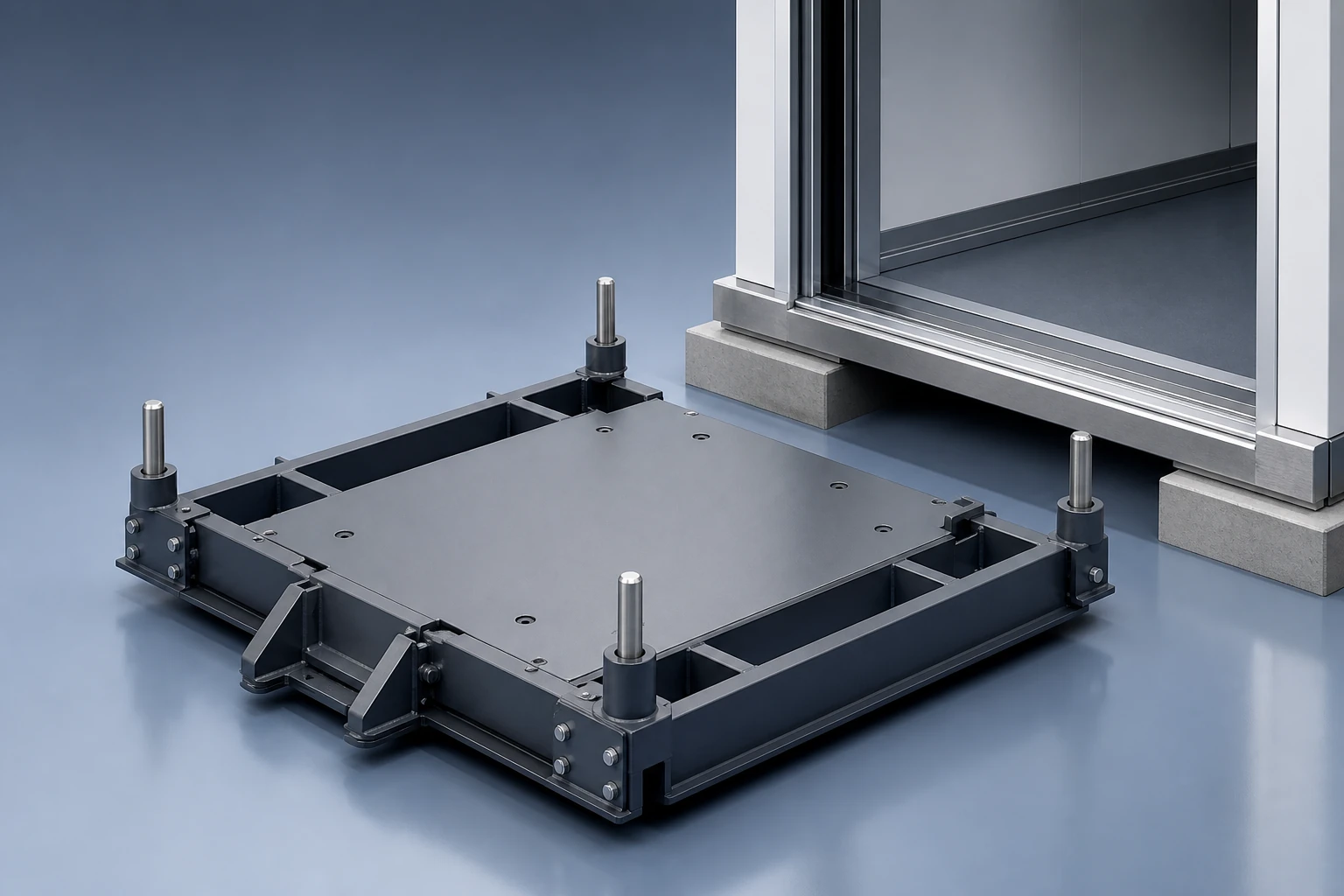
The transfer trolley is separate support equipment identified in OEM documentation for a specific withdrawable assembly. It is not the rolling frame installed in the cubicle. Its identification depends on the documented relationship between the support device, the withdrawable part, and the cubicle connection features.
Key mechanical features distinguish it from a handcart:
- Deck or support geometry identified for the relevant cubicle family.
- Model-specific catch, latch, or locating features where the OEM documentation calls for them.
- Guide channels, pins, or other interface details documented for the related chassis-truck assembly.
None of these features exist on a handcart. A handcart is a flat-deck or shelved wheeled platform built for boxes, tools, or general stores. It has no alignment interface, no latching mechanism, and no height match to a cubicle threshold.
Functional Role of the Handcart
A handcart is included in this comparison because the informal word “trolley” can be misread as a general-purpose cart. Its catalogue identity is fundamentally different from a transfer trolley because it has no OEM-defined switchgear interface. A handcart may have:
- No documented relationship to the switchgear cubicle or withdrawable part.
- No model-specific guide, catch, or locating feature.
- No evidence that it belongs in the relevant OEM support-equipment record.
A handcart is the right tool for moving cable drums, hardware kits, or relay modules across a switchroom. It is not an adequate substitute for a transfer trolley.
Interface and Configuration Dependencies
The critical procurement fact is that transfer trolleys and chassis trucks are both configuration-dependent. The variables used to identify the correct item include:
- Switchgear OEM and product series (for example, UniGear ZS1 versus UniGear ZS3.2 — different rail gauges).
- Rated current of the withdrawable part, because higher-rated trucks may have wider contact assemblies and therefore wider wheel spacing.
- Cubicle width (for single- versus double-width breaker compartments).
- Floor rail layout, if the facility uses embedded transfer rails rather than free-rolling trolleys.
A specification that reads only "one transfer trolley for MV switchgear" is incomplete. The RFQ must reference the switchgear series, the cubicle drawing number or arrangement drawing, and the withdrawable-part catalogue designation. The same interface categories are covered in the VCB chassis truck compatibility checklist, but the OEM document remains the deciding evidence.
Standards and Evidence Boundaries
IEC 62271-200 sets the assembly-scope context for metal-enclosed switchgear. It does not publish a universal transfer-trolley specification. Transfer-trolley identification is therefore left to the OEM support-equipment documentation for the relevant type-tested assembly.
This means:
- Compliance with IEC 62271-200 does not identify a universal support-equipment part number.
- Chassis-truck interchangeability claims must be backed by the OEM's documentation, not by dimensional similarity alone.
Model-specific approved procedures from the switchgear OEM govern all racking, insertion, withdrawal, and transfer operations. This article intentionally does not describe those procedures; they vary by product series and are controlled documents.
Documentation Set to Distinguish the Item
An RFQ or replacement review needs a documentation set rather than a generic request for a trolley:
- Switchgear series and vintage from the cubicle nameplate or original equipment schedule.
- OEM installation, operation, and maintenance manual for that series, including the service truck, transfer trolley, or support-equipment entry when present.
- Cubicle arrangement drawing and withdrawable-part catalogue designation.
- The exact requested item name: transfer trolley, chassis truck, or general-purpose handcart.
- OEM part number and the identified interface features recorded in the source documents.
The key distinction is simple: a chassis truck belongs to the withdrawable assembly; a transfer trolley belongs to the relevant support-equipment record; a handcart has no switchgear-specific interface record.
Failure Risks from Misidentification
The primary failure is misidentification in the documentation chain:
- The supplier cannot reconcile an unspecified “trolley” to the OEM catalogue record.
- A chassis-truck request can be misquoted as support equipment, or the reverse.
- A general-purpose handcart can be incorrectly treated as a substitute despite having no documented interface record.
- A missing drawing reference can leave the compatibility question unresolved.
These are procurement and evidence issues. Any operational decision belongs to the applicable OEM-approved procedure, not to this article.
Data Needed Before an RFQ or Replacement Decision
A compact summary of what the specification must contain:
| Data point | Where to find it | Why it matters |
|---|---|---|
| Switchgear OEM and series | Cubicle nameplate, single-line diagram | Determines every interface dimension |
| Withdrawable-part catalogue number | OEM parts list, breaker nameplate | Confirms chassis-truck compatibility |
| Rated current and voltage | Nameplate, equipment schedule | Higher ratings may use wider contact assemblies |
| Cubicle width | Arrangement drawing | Single- vs. double-width trolleys differ |
| Floor rail type (if any) | Civil or switchroom layout drawing | Free-rolling vs. rail-guided trolley selection |
| OEM manual revision | Document control register | Ensures current interface dimensions are used |
| Item needed: transfer trolley or chassis truck | Maintenance work order, clarified with engineering | Prevents the most common ordering error |
FAQ
What is a transfer trolley in MV switchgear?
A transfer trolley is OEM-documented support equipment associated with a particular withdrawable circuit-breaker or switch-disconnector family. Its identifying features may include model-specific supports, catches, or guide details. It does not replace the chassis truck that belongs to the withdrawable assembly.
What is the difference between a chassis truck and a transfer trolley?
The chassis truck is the integral rolling subframe of the withdrawable part. It is associated with the cubicle guide rails, racking mechanism, and defined interlocks. The transfer trolley is documented as support equipment, while the chassis truck is part of the withdrawable assembly. They are separate items with separate part numbers and separate mechanical interfaces.
What is the risk of using a handcart instead of a transfer trolley?
A handcart has no documented model-specific relationship to a switchgear cubicle or withdrawable assembly. It is a general-purpose material-handling item, not a named switchgear support-equipment interface. It should therefore never be treated as evidence of transfer-trolley compatibility in an RFQ.
What information is needed to order the correct transfer trolley?
The RFQ should include the switchgear OEM and product series, the withdrawable-part catalogue number, rated current and voltage, cubicle width, floor-rail type if applicable, and the revision of the OEM's installation and maintenance manual. Most importantly, the order must clearly state whether the required item is the transfer trolley or the chassis truck, because both are sometimes called "trolley" in informal maintenance language.
What standard governs transfer trolley design for MV switchgear?
IEC 62271-200 governs the overall metal-enclosed AC switchgear assembly. However, the standard does not prescribe a universal transfer-trolley design. The relevant OEM support-equipment documentation is therefore the binding reference for item identification.

