

Quick Takeaway
- Confirm the project duty and applicable requirements for Secondary Connectors and Control before selection or service work.
- Use recorded inspection and test evidence instead of unsupported assumptions.
- Keep the final acceptance, maintenance, and handover documents with the equipment record.
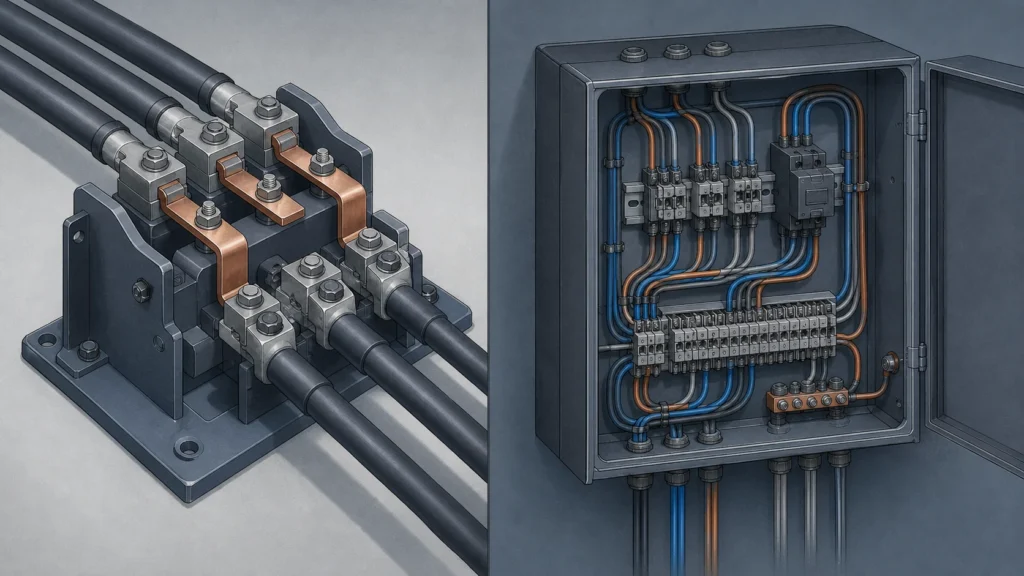
When a secondary circuit issue arises on medium- or high-voltage switchgear, the first decision is not what to order but what category of work is involved. Replacing a secondary disconnectable connector assembly is a component-substitution task governed by the breaker or switchgear OEM's parts documentation. Changing control-circuit wiring — adding conductors, re-routing signals, or altering termination schemes — is a design-controlled modification that triggers engineering review, updated drawings, and standards compliance verification under IEC 62271-1. Conflating the two scopes in a single work order or RFQ introduces procurement errors, delays factory acceptance, and can void type-test coverage in the secondary connectors and control components context.
| Dimension | Connector Replacement | Wiring Change |
|---|---|---|
| Scope trigger | Damaged, degraded, or obsolete plug/receptacle assembly | New interlock, relay relocation, signal addition, or circuit redesign |
| Governing document | OEM parts list and breaker-specific wiring diagram | Engineering change notice (ECN) with updated schematic |
| Standards exposure | OEM type-test validity maintained if like-for-like | IEC 62271-1 common specifications apply; re-verification may be required |
| Approval path | Maintenance planner / stores | Design authority / protection engineer sign-off |
| Drawing update | None if catalog part unchanged | Mandatory — both schematic and physical-routing drawings |
| Typical lead-time risk | Connector availability and cross-reference accuracy | Engineering review cycle, drawing revision, possible re-testing |
Why the Distinction Matters at the Planning Stage
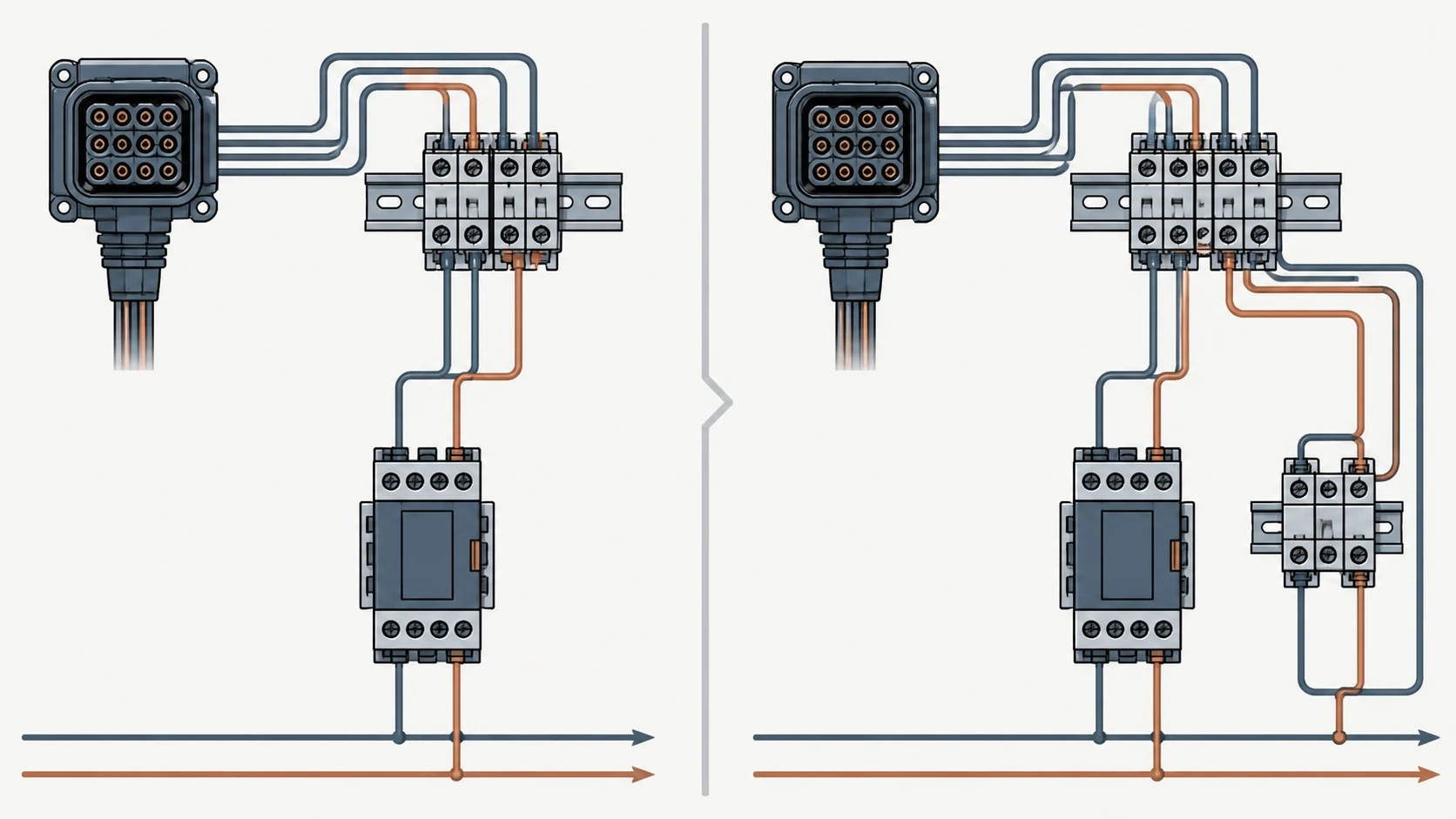
Secondary connectors on withdrawable circuit breakers serve a single mechanical function: they carry control, signaling, and auxiliary-supply circuits across the removable interface between the breaker truck and the switchgear cubicle. ABB's SecoVac installation and maintenance documentation, for example, identifies a secondary disconnectable plug as a discrete assembly paired with breaker-specific wiring diagrams. That pairing is deliberate. The plug's pin count, contact rating, and keying match a documented circuit allocation. Replacing that plug with the correct catalog equivalent preserves every upstream design assumption.
A wiring change breaks that preservation. Even a single added conductor — say, a new auxiliary contact feed for a bay-controller digital input — alters the circuit allocation the connector was sized and keyed for. The change may demand a connector with more poles, a different current rating, or a revised pin assignment. If the work order treats the whole job as "connector replacement," the procurement team sources a like-for-like part while the field crew expects a different one, or worse, the like-for-like part ships and the wiring change gets forced into an incompatible shell.
Keeping the scopes separate at the planning stage prevents this mismatch. It also keeps cost tracking honest: connector replacement is a maintenance expense; a wiring change is typically a capital or modification-budget item with its own approval chain.
Functional Boundary: What Defines Each Scope
A connector replacement is bounded by three conditions. First, the existing connector part number or cross-reference is identified from the OEM's parts documentation. Second, no conductor is added, removed, or re-terminated at a different pin position. Third, the replacement unit is mechanically and electrically interchangeable — same housing, same contact count, same insertion force and alignment features.
The moment any of those conditions is not met, the task has crossed into wiring-change territory. Common triggers include:
- A protection scheme upgrade that adds a trip-circuit-supervision loop requiring two new conductors through the secondary interface.
- Replacement of an electromechanical interlock relay with a programmable unit whose I/O wiring differs from the original terminal map.
- Retrofit of a condition-monitoring sensor that needs an analog signal pair routed through the disconnectable interface.
- Correction of a discovered wiring error documented in an as-built markup but never formalized in an ECN.
Each of these demands an updated schematic, a revised pin-allocation table, and review against the applicable standard before any connector is ordered.
Standards and Evidence Boundaries
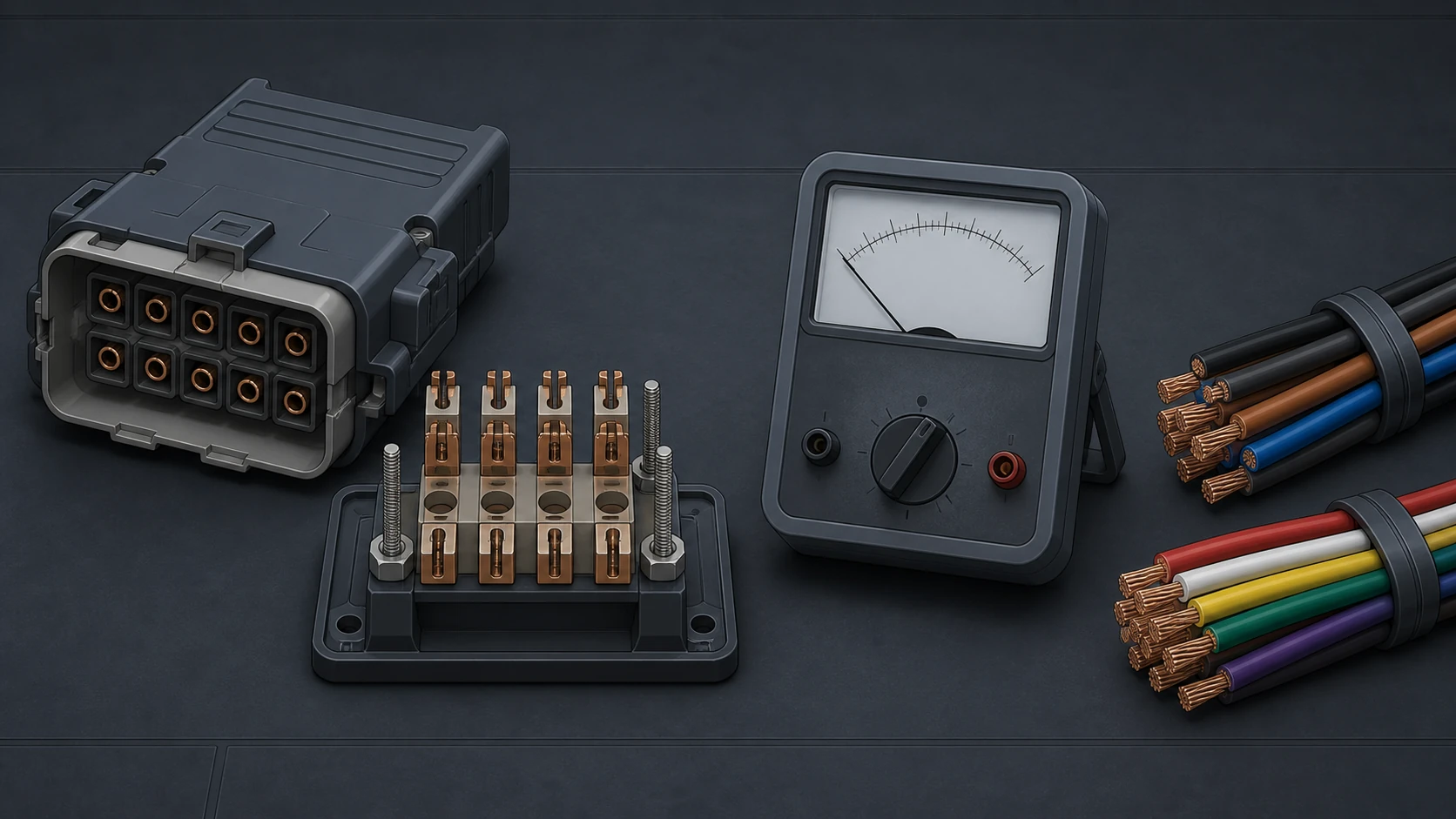
IEC 62271-1 provides common specifications for high-voltage switchgear and controlgear, including requirements for auxiliary and control circuits, insulation coordination, and environmental withstand. When a connector is replaced like-for-like, the equipment remains within the envelope validated by the OEM's original type tests. No additional standards verification is triggered, because nothing in the circuit design has changed.
A wiring change, however, may affect parameters that IEC 62271-1 governs: insulation clearance within the secondary terminal compartment, current-carrying capacity of auxiliary circuits, or the integrity of earthing continuity through the secondary plug. The standard does not prescribe how to perform a modification — that responsibility sits with the design authority — but it does define the performance envelope the modified equipment must still satisfy. Any wiring change that could affect these parameters must be reviewed against the standard's applicable clauses before execution.
This article stays at the scope-definition boundary. Model-specific approved procedures govern all live-operation, adjustment, and commissioning actions. The point here is narrower: knowing which standard clauses are engaged is part of defining scope, and scope must be defined before procurement begins.
Interface and Configuration Dependencies
Secondary disconnectable connectors are not generic commodities. They carry configuration dependencies that a wiring change can disturb and that a like-for-like replacement must respect.
Pin allocation is the most obvious dependency. OEM wiring diagrams — such as the breaker-specific diagrams ABB provides for the SecoVac — map each conductor to a specific pin position in the secondary plug. A connector with the correct housing but a different internal pin arrangement will mate mechanically while delivering signals to the wrong destinations. Cross-check this against the secondary-plug replacement checklist.
Keying and polarization matter next. Many secondary connector systems use mechanical keys or asymmetric housings to prevent a breaker from being inserted into the wrong cubicle. A wiring change that requires a higher-pole-count connector may also require a different key code, which in turn affects every cubicle in the lineup if breaker interchangeability is a design requirement.
Contact rating is a subtler dependency. Most secondary circuits carry milliamp-level signals, but some pins may serve motor-supply or heater circuits at several amps. A wiring change that reassigns a low-current pin to a higher-current function can exceed the contact's rated capacity without exceeding the connector's aggregate rating.
Practical Scope-Definition Workflow
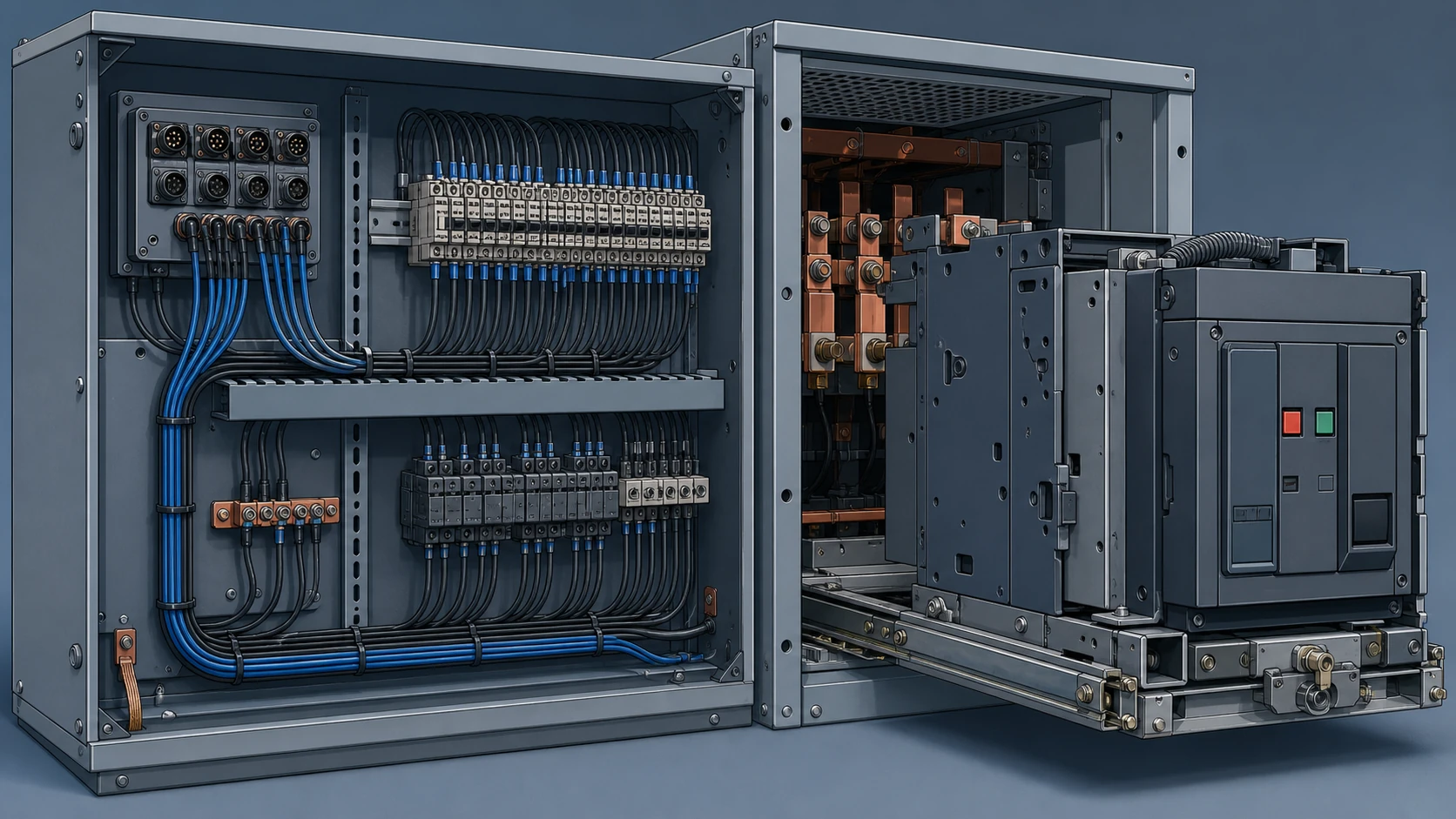
Before issuing an RFQ or writing a work order, the responsible engineer or planner should resolve five questions. Answering them in sequence prevents scope creep and keeps the two categories cleanly separated.
1. Is the existing connector part number positively identified from OEM documentation, and is an identical or OEM-approved cross-reference available? If yes, the task can proceed as a connector replacement. If no — because the part is obsolete, the documentation is missing, or no cross-reference exists — engineering review is required even if no wiring change is intended.
2. Does the planned work add, remove, or re-terminate any conductor at the secondary interface? A single "yes" moves the task into the wiring-change category regardless of whether the physical connector also needs replacement.
3. Has the current as-built wiring been verified against the latest approved drawing? Field wiring sometimes drifts from the drawing of record. Ordering a connector to match a drawing that does not match the installed wiring guarantees a mismatch at installation.
4. If a wiring change is confirmed, has the design authority issued or approved an ECN that includes an updated pin-allocation table, revised schematic, and identification of any affected IEC 62271-1 clauses? Procurement should not release an order until this document exists.
5. Does the change affect vacuum circuit breaker interchangeability within the switchgear lineup? If the answer is yes or unknown, the scope expands from a single cubicle to a fleet-level review, including the relevant MV switchgear components interfaces.
Data Required Before an RFQ
Connector replacement and wiring changes require different data packages at the procurement stage. Submitting the wrong package — or a hybrid that blurs the two — delays quoting and risks incorrect fulfillment.
For a like-for-like connector replacement, the minimum data set is the OEM part number or exact cross-reference, the breaker and switchgear type designation, the serial number or manufacturing date range of the installed equipment, and confirmation that no wiring change is associated with the order.
For a wiring change that also requires a new or modified connector, the data set expands to include the approved ECN number and revision, the updated pin-allocation table, the required contact ratings per pin, any keying or polarization requirements, and the mechanical envelope constraints of the cubicle's secondary compartment. Without these, a supplier cannot confirm that the quoted connector will satisfy the revised circuit design.
Procurement teams benefit from a simple gate: if the requisition does not include an ECN reference, it must be a like-for-like replacement, and the part number alone should be sufficient. If an ECN reference is present, the full data package must accompany the requisition. This binary gate eliminates the ambiguous middle ground where a wiring change is hidden inside a maintenance parts order.
Common Failure Modes When Scope Is Blurred
Three failure patterns recur when connector replacement and wiring changes are managed as a single scope.
The first is procurement mismatch. A planner orders a like-for-like connector while the field team expects a higher-pole-count variant to accommodate added conductors. The original part arrives, installation stalls, and an expedited order follows — doubling lead time and cost.
The second is undocumented modification. A technician adds a conductor to the existing connector without an ECN, updating neither the pin-allocation table nor the schematic. The next maintenance cycle, a different technician replaces the connector using the drawing of record, which no longer matches the installed wiring. The added circuit is lost, and the failure may not surface until the protection function it served is demanded.
The third is voided type-test coverage. A wiring change made without engineering review may alter insulation clearances or current loading beyond the limits validated by the OEM's original type tests. If a failure occurs and the investigation reveals an undocumented modification, warranty and insurance positions weaken. IEC 62271-1 compliance becomes difficult to demonstrate because the modification was never assessed against the standard's requirements.
All three failures share the same root cause: scope was not defined before work began.
FAQ
What is the difference between a connector replacement and a wiring change on switchgear secondary circuits?
A connector replacement is a like-for-like substitution of the disconnectable plug or receptacle assembly using the OEM part number or an approved cross-reference, with no change to conductor count, pin assignment, or circuit design. A wiring change involves adding, removing, or re-terminating conductors, which alters the circuit design and requires an engineering change notice, updated drawings, and review against applicable standards such as IEC 62271-1.
What is the risk of combining both scopes in a single work order?
Combining scopes leads to procurement mismatches, undocumented modifications, and potential loss of type-test coverage. The maintenance and engineering approval paths differ, the required procurement data packages differ, and the budget categories differ. A blended work order obscures accountability and increases the chance that a design-controlled change bypasses engineering review.
What is the role of IEC 62271-1 when replacing a secondary connector?
For a like-for-like connector replacement, IEC 62271-1 is not directly triggered because the equipment remains within its originally validated design envelope. When a wiring change is involved, the standard's common specifications for auxiliary circuits, insulation coordination, and environmental withstand become relevant, and the design authority must verify that the modified configuration still complies.
What is needed in an RFQ for a secondary connector that involves a wiring change?
The RFQ must include the approved engineering change notice number and revision, the updated pin-allocation table, per-pin contact ratings, keying or polarization requirements, and the mechanical envelope constraints of the secondary compartment. Without these, a supplier cannot confirm that the quoted connector satisfies the revised circuit design. If no ECN exists, the requisition should be held until the design authority completes its review.

