

Quick Takeaway
- Confirm the project duty and applicable requirements for Instrument Transformers before selection or service work.
- Use recorded inspection and test evidence instead of unsupported assumptions.
- Keep the final acceptance, maintenance, and handover documents with the equipment record.
A current transformer designed for metering and one designed for protection serve fundamentally different electrical objectives, and neither can substitute for the other without compromising accuracy or safety. The core distinction is not ratio or physical size but how the magnetic core behaves at different multiples of rated current. Declaring the intended use — metering or protection — before any specification work begins is the single most consequential step in a current transformer procurement, because every downstream parameter (accuracy class, saturation characteristic, burden limit, and acceptance test) follows from that declaration. In an installed lineup, this sits within the broader MV Switching Equipment evidence record.
| Decision factor | Metering CT | Protection CT |
|---|---|---|
| Primary function | Revenue-grade or process measurement accuracy at or near rated current | Reliable signal delivery to protective relays during fault currents many times rated current |
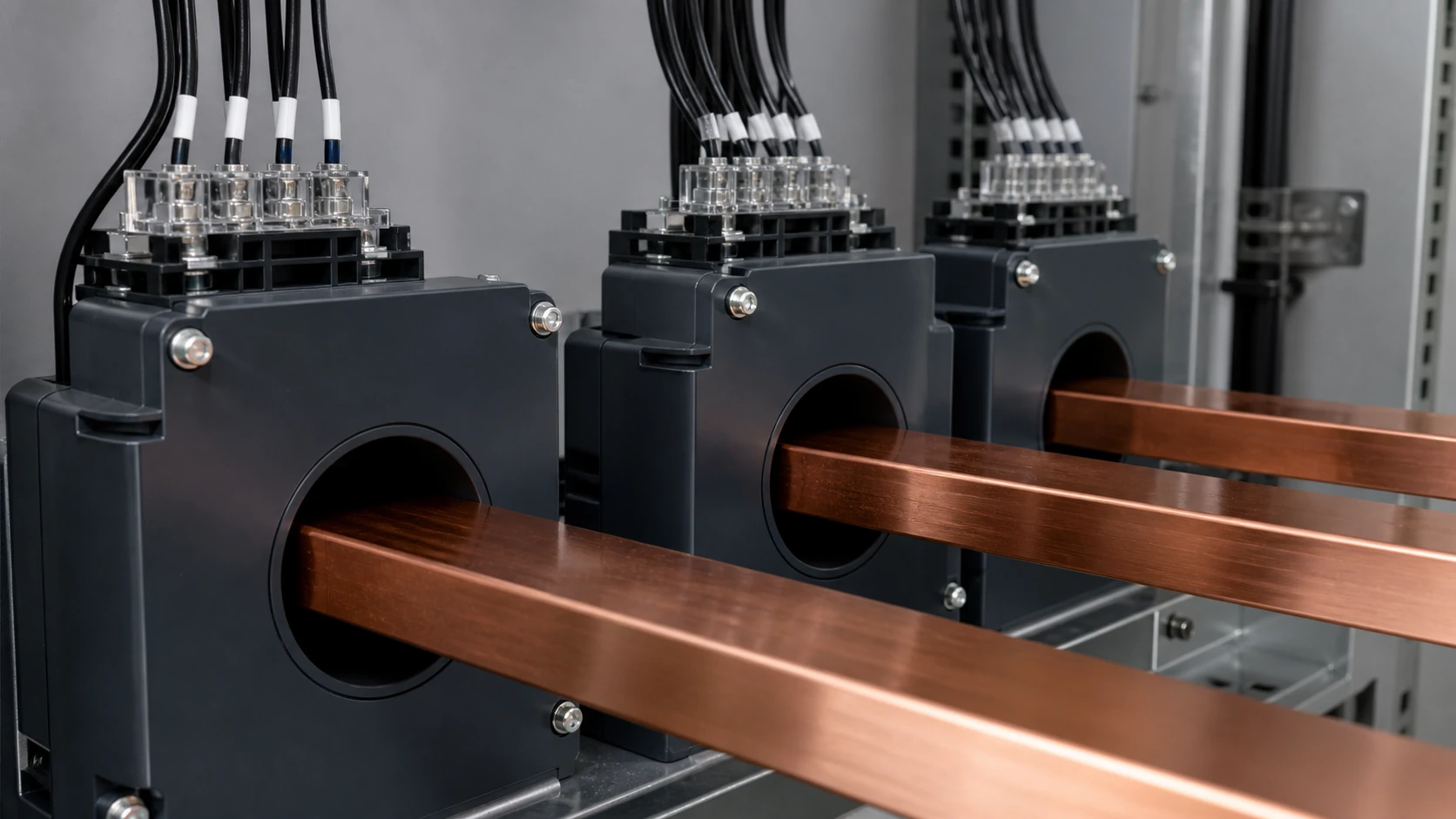
| Core behavior goal | High accuracy in the normal operating range (typically 5 %–120 % of rated current); designed to saturate early above that range | Faithful reproduction of current waveform up to high multiples of rated current (often 20× or more) before saturation |
| Accuracy-class family | Metering classes (e.g., 0.2, 0.5, 1.0 per IEC 61869-2) | Protection classes (e.g., 5P, 10P per IEC 61869-2, or relay accuracy classes per IEEE/ABB guidance) |
| Consequence of mis-declaration | Revenue error, billing disputes, metering non-compliance | Relay maloperation, delayed fault clearance, equipment damage, safety hazard |
| Saturation intent | Intentional early saturation protects meters and downstream electronics from fault-current energy | Intentional delayed saturation ensures relays receive enough signal to operate correctly during faults |
Why Core Saturation Defines the Use Boundary
The magnetic core inside a current transformer is the component that makes a metering CT and a protection CT electrically incompatible, even when they share the same ratio and mounting arrangement.
A metering core is manufactured with a grain-oriented steel and narrow hysteresis loop optimised for precision in the revenue-measurement band. It reaches magnetic saturation deliberately at relatively low multiples of rated current. This early saturation clips the secondary output during faults, shielding sensitive metering electronics from destructive energy. The tradeoff is that the core cannot faithfully reproduce the waveform once current exceeds the designed operating range.
A protection core is built to remain linear — to avoid saturation — well into the fault-current region. Protective relays need an accurate representation of the fault waveform to make correct trip decisions within milliseconds. If the core saturates too early, the relay sees a distorted, lower-magnitude signal and may fail to operate, or may operate too slowly. The tradeoff is that a protection core is not optimised for the tight ratio and phase-angle accuracy that revenue metering demands at normal load.
These are opposing magnetic design objectives. No single core optimises for both, which is why IEC 61869-2 and the ABB Utility Instrument Transformer Reference Guide treat metering and protection accuracy classifications as separate documentation families. The standard applies to current transformers serving measuring instruments and to those serving protective devices, but it requires the intended duty to be explicitly identified because the acceptance criteria, test procedures, and performance evidence differ.
How Accuracy Classes Encode the Intended Use
Accuracy class designations are not interchangeable labels. They encode the electrical behaviour expected at specific operating points, and those operating points depend entirely on the declared use.
Metering accuracy classes — such as 0.2, 0.5, and 1.0 under IEC 61869-2 — define permissible ratio error and phase displacement at fractions and multiples of rated current within the normal measurement band. A class 0.2 CT, for example, must meet tight error limits at 5 %, 20 %, 100 %, and 120 % of rated current. These limits exist to ensure billing integrity and process-measurement confidence. Outside that band, the metering class says nothing useful about performance.
Protection accuracy classes — such as 5P and 10P — define the composite error permitted at the rated accuracy limit factor, which is a stated multiple of rated current (commonly 5, 10, 15, or 20 times). A 5P20 designation, for instance, means the composite error must not exceed 5 % at 20 times rated current. This tells the relay engineer that the CT will still deliver a usable signal at that fault level. At normal load, the same CT may meet a loose accuracy band, but it is not certified to the tight limits a revenue meter requires.
The ABB Utility Instrument Transformer Reference Guide reinforces this separation by presenting metering accuracy and relaying accuracy as distinct classification families with different documented expectations. The practical consequence is that an RFQ that states a ratio and burden without declaring metering or protection duty is incomplete. The manufacturer cannot select a core, the test laboratory cannot choose the correct acceptance procedure, and the buyer cannot verify that the delivered product matches the installation need. Related selection evidence can be reviewed in the Technical Articles library.
Why Dual-Use Windings Do Not Eliminate the Declaration Requirement
Multi-core current transformers are common in utility and industrial applications. A single CT housing may contain one metering core and one or more protection cores, each with its own secondary winding. This physical packaging sometimes creates the impression that the CT "does both," removing the need to declare intended use.
That impression is incorrect. Each core inside the housing is designed, tested, and certified independently for its declared duty. The metering core carries its own accuracy class, rated burden, and test certificate. The protection core carries a different class, a different accuracy limit factor, and a different test protocol. The declaration of intended use is made per core, not per housing.
During procurement, the RFQ must state the number and type of cores required: for example, one 0.5-class metering core at a stated burden and one 5P20 protection core at a stated burden. Omitting this detail, or writing a single generic line item for "current transformers," forces the manufacturer to assume the split — or to ask, which delays the quotation — and removes the buyer's ability to verify the delivered configuration against the installation need. The product range is a starting point for family identification, not a substitute for this evidence package.
Evidence Boundaries: What This Declaration Controls and What It Does Not
Declaring the intended use — metering or protection — is the entry gate to the specification process. It controls which evidence family applies. It does not, by itself, determine the specific class, ratio, burden, rated accuracy limit factor, or relay settings. Those parameters require further engineering that is outside the scope of the use-declaration decision.
The boundary matters for procurement teams and project engineers because it prevents two common errors. The first error is specifying a protection CT where a metering CT is needed, which may result in revenue-measurement non-compliance. The second error is specifying a metering CT where a protection CT is needed, which may result in relay maloperation during faults.
IEC 61869-2 establishes this boundary explicitly: the standard covers inductive current transformers for measuring instruments and for protective devices, and the declared use determines which set of requirements, test sequences, and acceptance criteria apply. The ABB reference guide similarly requires that the intended metering or protection duty be stated in an RFQ so that the correct accuracy classification family is selected and the correct documented expectations are applied.
Selecting a specific accuracy class within the declared family, sizing the burden, choosing a ratio, or configuring relay settings are downstream engineering tasks. They depend on system studies, load profiles, fault-level calculations, and relay coordination — none of which can begin until the intended use is declared.
Practical RFQ Review: Questions That Prevent Mis-Declaration
Before issuing or reviewing an RFQ for current transformers, the following questions isolate whether the intended use has been properly declared and whether the downstream evidence requirements are aligned.
First, does every CT line item in the RFQ explicitly state metering duty, protection duty, or both (with separate core specifications for each)? If the line item says only "current transformer" with a ratio and burden, the use is undeclared and the specification is incomplete.
Second, does the stated accuracy class belong to the correct family for the declared use? A class 0.5 designation on a line item labelled "protection" is a mismatch. A 5P20 designation on a line item labelled "revenue metering" is equally wrong. The accuracy class must correspond to the declared duty.
Third, for multi-core CTs, does the RFQ specify the number of cores and the declared use of each? A housing with two cores requires two declarations: one per core.
Fourth, does the acceptance-test clause in the purchase order reference the correct test sequence for the declared use? Metering cores and protection cores undergo different routine and type tests under IEC 61869-2. A generic "test per IEC 61869" clause without specifying which accuracy tests apply can allow the wrong test to be performed — or the correct test to be omitted.
Fifth, is the declared use consistent with the downstream connected device? A core feeding a revenue meter must be declared and certified for metering duty. A core feeding a protective relay must be declared and certified for protection duty. If the connected device changes during a project revision, the CT declaration must be reviewed and updated.

Replacement and Retrofit Decisions
When an existing current transformer is replaced or a metering/protection scheme is retrofitted, the intended-use declaration is just as critical as in new construction, and it is more frequently overlooked.
A common failure mode is like-for-like replacement based solely on ratio and physical dimensions. If the original CT's intended use is not confirmed against the connected circuit, a protection core may be installed in a metering circuit or vice versa. The replacement may fit physically and produce a secondary current at the correct ratio, yet fail to meet the accuracy or saturation requirements of the application. In a metering circuit, this means measurement error. In a protection circuit, this means potential relay maloperation — a safety and reliability risk that may not become apparent until a fault occurs.
Before ordering a replacement CT, confirm the intended use from the original nameplate data, the station single-line diagram, or the relay/metering panel schedule. If the original nameplate is unreadable or missing, trace the secondary wiring to identify the connected device. The connected device — meter or relay — determines the required declaration. Model-specific installation, removal, and commissioning procedures govern the physical replacement work; those approved procedures must be followed and are outside the scope of this decision guide.
When Mis-Declaration Creates a Latent Risk
The most consequential aspect of metering-versus-protection mis-declaration is that it often produces no visible symptom during normal operation. Both CT types output a secondary current proportional to the primary current under normal load conditions. The difference only manifests at the extremes: during fault events for a protection CT, or during precise low-load measurement for a metering CT.
A protection CT installed in a metering circuit may read within a tolerable band at rated load, passing routine checks, while introducing a ratio error at low loads that slowly accumulates into a billing discrepancy. The error is real but hidden until a metering audit or calibration test reveals it.
A metering CT installed in a protection circuit operates correctly during every normal hour of the year. During a fault, its core saturates early, the relay receives a clipped waveform, and the trip decision is delayed or missed. The failure appears as a relay performance issue, not a CT issue, which complicates root-cause investigation. The actual cause — a CT whose declared use does not match the circuit duty — may not be identified until a thorough review of the CT nameplate and certification documents is conducted against the protection scheme design.
Both scenarios are preventable by declaring and verifying the intended use at the point of procurement and again at the point of installation.
FAQ
What is the main difference between a metering CT and a protection CT?
The main difference is magnetic core design intent. A metering CT core is optimised for high accuracy at or near rated current and saturates early above the normal operating range. A protection CT core is optimised to remain unsaturated at high multiples of rated current so that protective relays receive a faithful fault-current signal. These are opposing design goals, which is why the intended use must be declared before selecting an accuracy class, burden, or test protocol.
What is the consequence of not declaring the intended use in an RFQ?
Without a declared intended use, the manufacturer cannot select the correct core type, the correct accuracy class family cannot be applied, and the correct acceptance test sequence cannot be performed. The result may be a CT that is physically correct but electrically unsuitable for the circuit it serves — leading to measurement error in a metering application or relay maloperation in a protection application.
What is the role of IEC 61869-2 in the metering-versus-protection distinction?
IEC 61869-2 applies to inductive current transformers used for measuring instruments and for protective devices. It requires that the intended use be declared because the accuracy classes, performance requirements, and test procedures differ between metering and protection duties. The standard does not treat these as interchangeable; each duty has its own evidence family.
What is a dual-core CT, and does it remove the need to declare intended use?
A dual-core (or multi-core) CT houses more than one magnetic core and secondary winding inside a single physical enclosure. Typically, one core is designed for metering duty and another for protection duty. Each core must be independently declared, specified, and tested for its intended use. The physical packaging does not eliminate the declaration requirement — it doubles it, because each core serves a different function with different acceptance criteria.
What is the risk of replacing a CT based only on ratio and physical fit?
A replacement CT that matches the original in ratio and mounting dimensions may have a different core type — metering instead of protection, or vice versa. Under normal load, the replacement may appear to function correctly. The mismatch only manifests during a fault (if a metering core replaced a protection core) or during a precision calibration audit (if a protection core replaced a metering core). Confirming the intended use from the original nameplate, single-line diagram, or connected-device identification is essential before ordering a replacement.

